
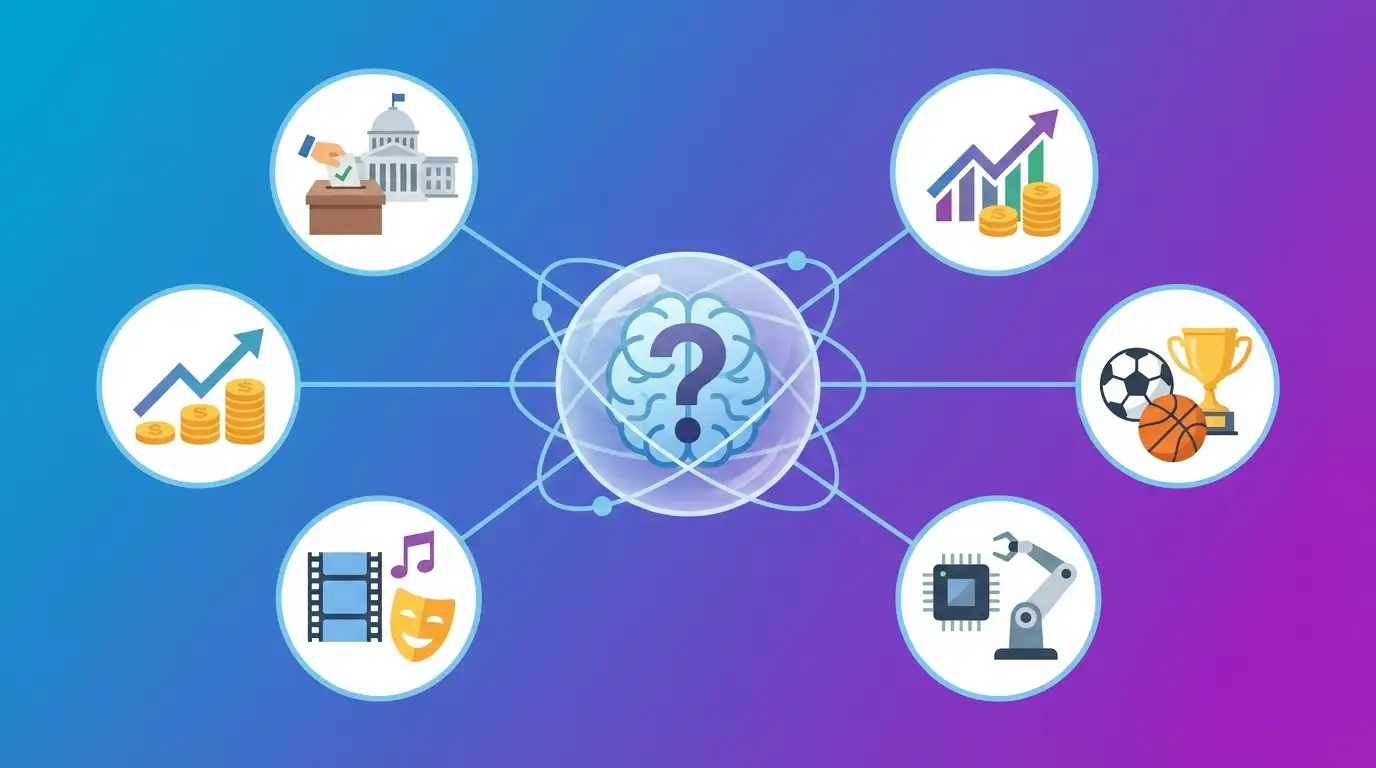
Unlike traditional markets where you bet on companies or assets, prediction markets offer contracts on events such as elections, conflicts or sports. In a world of headlines, these markets have grown tremendously to let people express what they think could happen next.
According to the International Journal of Forecasting, prediction markets are more accurate than polls 74% of the time. Now thanks to technology, anyone can participate in collective forecasting.
This guide provides an overview to help you understand and make the most of these markets. Topics explored here include:
- Where prediction markets came from
- How they work and who uses them
- Why they are becoming important
- What are opportunities and risks
History of prediction markets
From informal bets to institutional research, prediction markets have long existed before coming into retail folks’ portfolios.
Early origins
Betting markets have existed for centuries. In the 19th century, people wagered on elections long before formal markets emerged, and newspapers reported odds as early indicators of outcomes. In economic and social sciences, early researchers used such markets to explore how individual expectations could combine to form collective predictions.
Academic experiments
The modern era began in the late 1980s with the Iowa Electronic Markets (IEM) at the University of Iowa, where traders exchanged contracts on U.S. elections, consistently outperforming opinion polls.
In 2003, the U.S. Defense Advanced Research Projects Agency (DARPA) proposed the Policy Analysis Market to forecast geopolitical events in the Middle East. Though the project faced public backlash and was canceled, it highlighted the power and controversy of using market mechanisms to predict real-world outcomes.
Modern markets
Today’s prediction markets attract a global user base with online platforms such as PredictIt, Kalshi and Polymarket allowing retail and institutional users to bet on all kinds of events.
Blockchain has led to the emergence of decentralized markets, letting users trade using smart contracts. This shift has raised interest from media outlets and policymakers eager to understand how collective intelligence can shape future planning.
Why prediction markets can be powerful
The way these markets aggregate information make them extremely valuable in decision-making.
Forecast accuracy
Prediction markets incentivize true insights. As traders profit only if their information or analysis proves correct, markets showcase the wisdom of crowds: combined decisions are often superior to individual guesses.
Studies like this about the 2024 U.S. presidential election show that these markets tend to be more accurate than polls and surveys. The key reason is real-time updating: when a news hits the wire, prices change immediately to take into account fresh data.
Therefore, markets replace narratives with hard data, no wonder that policymakers, journalists and corporate leaders use their signals to detect emerging trends or early warnings.
Real-world applications
More than just betting venues, prediction markets now power political forecasting, risk assessment and corporate planning. They help economists assess inflation trends or firms track projects. For example, Google had used internal markets to forecast on COVID-19 and emerging technologies.
In scientific and technological contexts, they reveal research timelines and the pace of innovation.
For the average person, these forecasts may show meaningful trends in . For example, “Will GPT have ads by March 2026?”
Overall, markets turn uncertainty into measurable insight, a powerful asset in any information economy.
How prediction markets work
In this section, we’ll look at some basic concepts of collective predictions.
Types of contact
Prediction markets trade contracts whose value depends on a future event, with each one paying $1 if the event happens or $0 if it does not. Here are the two most common types:
- Binary contracts with “YES” and “NO” outcomes, such as “Will candidate X win the election?” or “Will company Y beat quarterly earnings?”
- Multi-outcome contracts with several possibilities, like “NBA MVP of the year.” or “Bitcoin price on January 31?”
Price and probability
Each price shows a probability which is what the crowd believes has a chance of happening. If a contract trades at $0.60, it means the market believes there is a 60% chance it will happen. Upon settlement, holders of winning contracts receive $1 ($0.40 profit), while losing ones expire worthless.
Market efficiency depends on liquidity and volume as greater participation leads to more accurate price discovery, while lower activity can result in wider spreads and higher transaction costs.
Resolution and settlement
Resolution and settlement are key components as they define how and when these event contracts pay out. A well‑designed market will publish clear resolution criteria so you know what you are betting on, specifying:
- Data source
- Time window
- Conditions that count as “happening” or “not happening”
After the event, the platform checks its sources, for example, official statistics releases and then settles contracts, paying 1 for “yes” in binary or for the correct answer in multi-outcome.
In decentralized markets, resolution is handled by oracles or governance tokens for transparency and censorship resistance but can also introduce coordination and governance risks if criteria are not crystal clear.
Decent platforms also make clear how they handle edge cases such as postponements, partial outcomes or conflicting reports, since ambiguity can cause disputes and undermine trust in the market.
Disputes
Disputes arise when traders believe a proposed outcome does not match the published data. Centralized platforms manage disputes through internal review or arbitration, sometimes with a short challenge window in which users can submit evidence before the result is set in stone.
Decentralized markets have challenge periods, where anyone can post a bond to dispute a resolution and escalate the question to token‑holder votes or a separate data verification mechanism.
In systems like UMA or Augur, disputers who are correct are rewarded and those backing incorrect outcomes can lose part or all of their stake, creating strong incentives to contest only when they have high‑quality evidence.
Which markets are traded
The diversity and accessibility of these markets are one of the reasons why they are sought after by traders, policymakers and institutions.
Political and geopolitical: These markets predict elections, leadership changes and military conflicts. They can be highly influenced by news headlines and offer real-time insights into crowd sentiment.
Economic and financial: They estimate macroeconomic outcomes like inflation, interest rate cuts or recessions, and company financials like earnings, market shares or stock prices. By signaling expectations before official data releases, they offer unique foresight into market trends.
Corporate and industry: Corporate markets forecast sales or mergers. For example, you can bet on the next Apple product launch or “GTA 6 postponed?”
Science and technology: They track technological breakthroughs, adoption rates or scientific discovery timelines, helping investors and institutions allocate resources effectively. Popular markets include “Best AI model” and “Will the U.S. confirm that aliens exist before 2027?”
Sports and entertainment: Markets also cover sports championships and major media events, offering both entertainment and insight into public opinion. Hot markets include “Top Netflix Show this week?” or “Top artist on Spotify this year?”
Who are the market participants
Prediction markets bring together a diverse range of participants:
- Retail traders speculate on event probabilities for profit.
- Experts and insiders, where legally allowed, trade based on domain knowledge.
- Hedgers offset real-world risks such as companies with political or economic exposures.
- Researchers and journalists use prices to read public sentiment.
- Liquidity providers maintain active markets and reduce trading friction.
This mix of motives and sources enhances market quality, building an ecosystem that reflects the broader economy and society.
Why trade prediction markets
Prediction markets offer unique benefits compared to traditional investing and betting.
- Accessibility: Monetize directly your knowledge across any domain.
- Simplicity: Trade with no expertise as many contracts have intuitive questions such as “Will the temperature be X tomorrow?” or “Will movie Y win an Oscar?”
- 24/7 markets: React to news or market moves in real time instead of waiting for other markets to open.
- Low entry barrier: Start with as little as $5.
- Fast settlement: Winning trades pay out instantly on event resolution.
- Market inefficiencies: Over- or underpriced contracts offer opportunities to those who have a keen eye.
- Risk mitigation: Hedge your traditional portfolio against recession or geopolitical uncertainty.
- Privacy: Crypto‑based markets have minimal KYC, so there is no giving away personal data.
What are the risks
Before diving in, potential traders must be aware of the risks associated with prediction markets.
Market risk: Any breaking news or sudden leaks can reverse prices, while herding behavior can create short-term mispricing, causing large position swings or drawdowns.
Liquidity risk: A prediction market can suffer from low participation, some markets only have a few thousand dollars of volume, leaving prices unstable or prone to manipulation.
Resolution risks: Poorly defined resolution criteria can lead to disagreement over outcomes.
Structural risk: Platform instability or lack of governance can undermine confidence.
Counterparty risk: On centralized platforms, traders may struggle to collect their wins if the counterparty defaults.
Regulatory risk: Some jurisdictions see prediction markets as gambling while others treat them as financial derivatives, limiting participation.
Legal risk: Crypto-native markets are in a grey area where recognition and enforcement can be complex.
What are the common misconceptions
On a final note, below are some popular misconceptions about prediction markets.
“Prediction markets are just gambling.” While they are betting, prediction markets aggregate information through prices, which often makes them powerful forecasting tools rather than mere games of chance.
“Prices reflect what people want to happen.” Traders are incentivized to trade based on what they believe will happen, since profits depend on accuracy, not preference.
“Prediction markets are easily manipulated.” Attempts at manipulation often create opportunities for informed traders who push prices back toward more accurate levels.
“You need inside information to win.” Most edge comes from better analysis of public information or probabilistic reasoning, not privileged access.“
Market prices are exact probabilities.” Prices are estimates of probability, which can be distorted by factors like liquidity, fees or behavioral biases.
Conclusion
Prediction markets are a fundamentally different approach to seeing the future. Rather than relying on polls or expert opinion, they harness the collective intelligence of participants who put their money where their beliefs are, creating a powerful tool for processing information under uncertainty.
More than just betting, these markets combine the logic of trading with the science of forecasting backed by hard data. You may benefit even if you never trade as policymakers and businesses use them extensively for planning purposes. If you do, they turn opinions into actionable opportunities.
You might be interested in: