
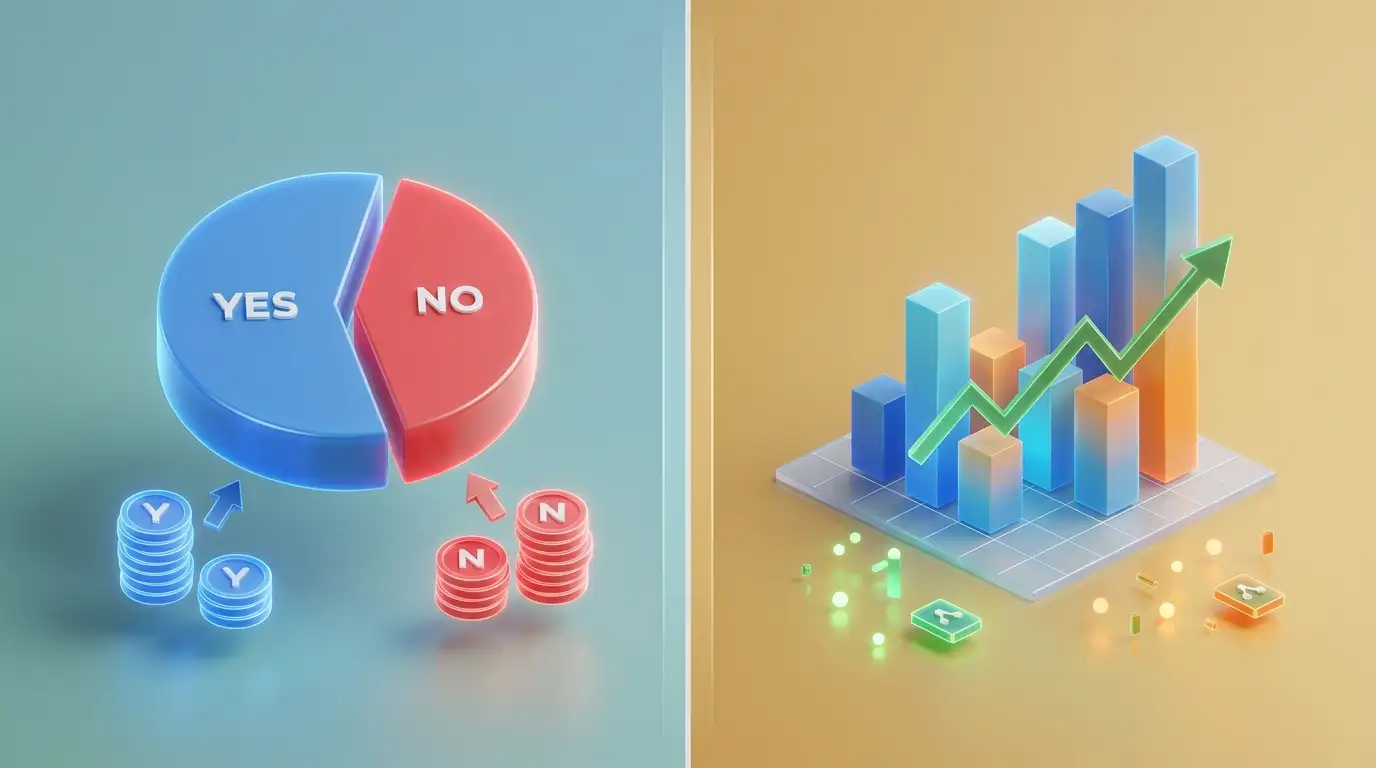
The global stock market is worth over $100 trillion while prediction markets are only a fraction of that. As we expect the latter to grow into something much bigger in the next few years, their comparison is inevitable.
Both markets might look similar on the surface with prices moving up and down and people placing bets on outcomes, prediction markets and stock markets are fundamentally different. Understanding how they each work can sharpen the way you think about risk and how markets actually price things.
In this article, we’ll cover:
- How each market works and what you’re actually buying or selling
- The core purpose of each market
- Who shows up to trade, and what they’re trying to get out of it
- How regulation shapes each market differently
- The key risks and limitations to be aware of
Market mechanics
Let’s start with the basics. Each market comes with some fundamental differences.
Company ownership
When you buy a stock, you’re picking up a small ownership stake in a company. If the company grows, so does your investment. Stocks can also pay out dividends which are regular cash payments to shareholders.
What you’re really trading is a claim on a company’s future value, which means you’re constantly trying to figure out whether a business is going to do well or not.
Event outcome
Prediction markets work differently. Here, you’re buying a contract tied to whether a specific event will happen. A typical contract might be: “Will candidate X win the 2026 midterm election?” or “Will the Fed cut rates before June?”
The contract pays out $1 if the answer turns out to be yes, and $0 otherwise. So if a contract is priced at $0.65, the market is saying there’s a 65% chance that event happens. You’re not owning anything, you’re taking a position on probability.
This is the fundamental fork in the road between the two. Stocks deal in continuous value while prediction markets deal in binary outcomes.
Purpose and accuracy
Each market plays a distinct role despite large sums of money involved.
Capital allocation
Stock markets exist to do two big things: help companies raise capital and give investors a way to build wealth over time. When a company goes public, it raises money it can put to work, hiring and expanding. Investors, in turn, get a liquid asset they can buy and sell.
Information aggregation
Prediction markets were built with a different goal in mind: to aggregate information. The idea, rooted in economist Friedrich Hayek’s work on the price system, is that prices can carry knowledge that no single person or institution holds on their own.
When people put real money on an outcome, they have a strong incentive to bring their best information to the table. The result, in theory, is a crowd-sourced probability estimate that’s more accurate than expert opinion.
Market efficiency
How well does each market actually deliver on this? Stock markets are generally considered to be fairly efficient, meaning prices tend to reflect available information pretty quickly, especially for large companies. Though bubbles happen as sentiment can drive prices away from fundamentals for extended periods.
Prediction markets have racked up some impressive accuracy records. Research from institutions like Oxford and George Mason University has found that they often outperform polls, expert panels, and even internal forecasts at companies. During the COVID-19 pandemic, some prediction markets called key policy decisions and drug approval timelines ahead of official announcements. That said, they can break down when liquidity is thin or when a small number of well-funded traders skew the odds.
Key participants
Knowing who participates in these markets helps understand their liquidity and price dynamics.
Stock markets pull in a huge and diverse crowd.
- Institutional players such as pension funds, hedge funds, and mutual funds that account for around 80% of all U.S. stock trading volume.
- Retail investors have piled in more than ever, particularly after the COVID-era trading boom.
Traders are in for wealth building, portfolio diversification or short-term alpha. Most of them aren’t trying to predict a specific event, but to pick winners.
Meanwhile, prediction markets draw a more niche crowd.
- Forecasters and researchers who treat these platforms as serious tools
- Speculators hunting for mispriced probabilities.
- Journalists or analysts who use the markets to track public sentiment in real time.
Because the participant base is smaller and more specialized, prediction markets can be more susceptible to the influence of a handful of big players, something that’s much harder to pull off in a liquid stock market.
Regulation and legal status
This is where the two markets really part ways. Stock markets are heavily regulated in developed countries like the U.S. and the EU. There are strict rules around market manipulation and investor protection.
This framework has been built up over nearly a century, and provides a well-understood legal foundation for the trillions of dollars that flow through the market every day.
In contrast, prediction markets have had a much harder time figuring out where they fit in. Most regulators have treated event contracts as a form of gambling, meaning that most platforms have to either operate offshore or limit their user base.
For now, prediction markets operate under significantly more legal uncertainty than their stock market counterparts, but things are starting to shift after Kalshi’s landmark legal battle in the U.S. and Polymarket’s CFTC settlement. We can expect the regulatory landscape to catch up soon.
Risks and limitations
Both markets carry real risks, though they tend to show up differently.
Macro and company risks
In stock markets, the big risks are familiar ones: company-specific downturns, broader economic contractions and interest rate shifts. There’s also the behavioral risk such as panic selling, FOMO buying, that can cause investors to act against their own long-term interests. Market manipulation does happen, but it’s difficult to carry out at scale in deep markets and is aggressively prosecuted when caught.
Liquidity and resolution risks
Prediction markets come with a different set of challenges. Liquidity is often thin, especially for niche or long-dated events. When not many people are trading a contract, the price becomes less reliable as a probability estimate, one large trade can move it dramatically.
There’s also the question of event definition: if a contract is poorly worded, disputes can arise over whether the resolution criteria were actually met, undermining confidence in the whole system. And because these markets are newer and less regulated, the infrastructure around them, custody, dispute resolution, recourse if a platform shuts down, is less mature than what stock market investors take for granted.
As a recap, here‘s a quick comparison of prediction market and.stock market.
| Stock market | Prediction market | |
|---|---|---|
| Purpose | Capital raisingInvestor wealth buildingOngoing price discovery | Crowd knowledgeEvent forecastBinary outcomes |
| Participants | Institutional investorsLarge retail base | ResearchersInstitutional hedgersRetail speculators |
| Regulation | SEC and FINRAStrong investor protections | Legally grayWidely treated as gambling |
| Risks | Economic downturns and rate sensitivityBehavioral risksManipulation difficult but possible | Thin liquidityManipulationImmature infrastructure |
Conclusion
Prediction markets and stock markets are designed to do different things. Stocks are built for long-term capital allocation and wealth creation, and prediction markets are built for collective knowledge.
What makes both worth paying attention to is that they’re each, in their own way, trying to solve the same hard problem: figuring out what’s true before it becomes obvious. As prediction markets continue to mature and regulation starts to catch up, they may give investors and policymakers a richer set of tools for navigating an uncertain world.
Frequently asked questions
What’s the main difference between a prediction market and a stock market?
A stock market lets you buy ownership in a company and profit as it grows. A prediction market lets you trade contracts on whether an event will happen. One is open-ended, the other resolves to yes or no.
Can you make money on prediction markets?
Yes, if you consistently identify mispriced probabilities. If the market prices an event at 40% and you believe the real odds are closer to 70%, there’s an edge to exploit. However, thin liquidity and platform risk make it harder to scale than stock market investing.
Are prediction markets legal in the U.S.?
For years, most event contracts were treated as gambling and blocked under CFTC rules. That’s starting to change after Kalshi won a landmark case in 2023 allowing federally regulated political contracts. But plenty of gray area still remains, and many platforms operate offshore to get around U.S. restrictions.
Are prediction markets more accurate than polls?
Often, yes. Research from Oxford and George Mason University suggests prediction markets frequently outperform polls and expert panels, because participants have a financial incentive to bring their best information.
Can I use both markets together?
Absolutely. Some investors use prediction markets to hedge political or macroeconomic risk in their stock portfolios, for example, taking a position on an election outcome that could hit a specific sector.
What are the biggest risks unique to prediction markets?
Three stand out: thin liquidity, contract ambiguity and platform risk.
You may be interested in these articles: