

Prediction markets have become one of the most engaging ways to express views about future events. Unlike traditional financial markets where you’re betting on companies or assets, these let you trade on elections, geopolitics, economic indicators and more.
These markets saw explosive growth in recent months with an average of 4.4 billion dollars in December 2025 according to Dune Analytics, a blockchain data platform.
This guide helps you understand and trade these markets. We’ll be covering:
- Definition of prediction markets
- Major platforms and their features
- Basic trading concepts
- Popular strategies
- Risks and long-term edge
What are prediction markets
Prediction markets are exchange-traded markets where participants buy and sell contracts that pay out on future events. Each contract represents a specific outcome, “Will oil prices hit $30 by year’s end?” or “Will a ceasefire be declared in Ukraine by June?”, and trades at prices between $0 and $1. These prices reflect the market’s probability estimate.
The concept traces back to the Iowa Electronic Markets in 1988 and Intrade (2001-2013). The modern era began around 2020 with platforms like Polymarket and Kalshi, making prediction markets more accessible.
These markets often outperform traditional polls and expert predictions because they process new information within minutes, while polls take days. Most importantly, participants have financial incentives to be correct: when someone sees a mispricing, they can profit from it, creating a self-correcting mechanism.
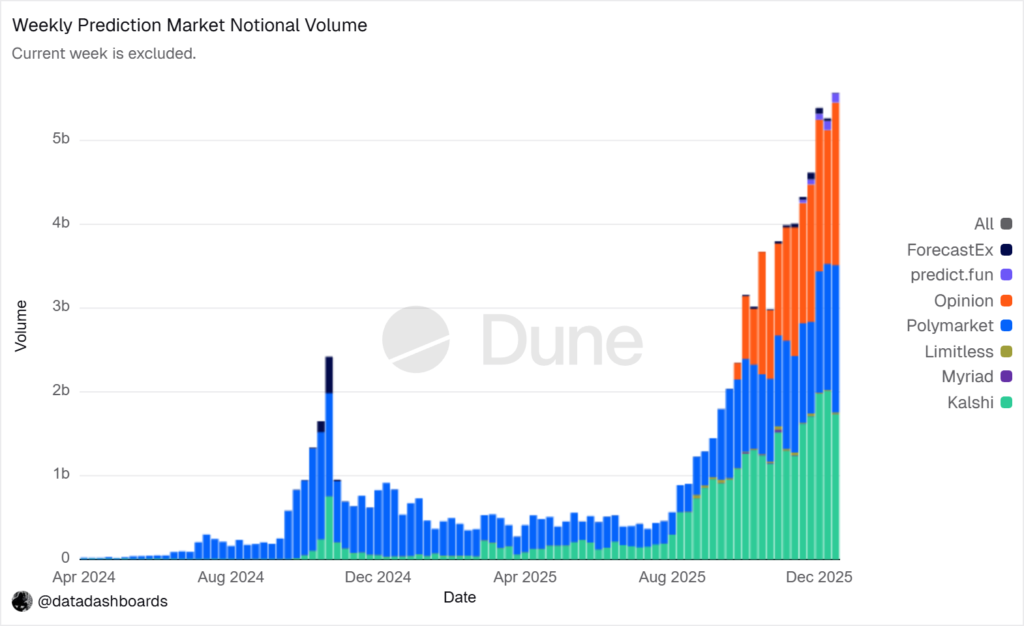
Source: Dune Analytics
How prediction markets work
At their core, prediction markets trade event contracts based on:
- A clear question
- A defined outcome
- A resolution date
Questions might be binary: “Will the S&P 500 close above 7,000 on January 31?” or multi-outcome: “Who will be the next Fed Chair?”. At the resolution date, each winning contract receives $1 while losing contracts expire worthless.
Let’s say you buy 100 “YES” contracts at 45¢ each, or $45 in total.
- If the market ends up being “YES”, you get paid $1 per contract, or $100 in total, making a $55 profit.
- If “NO”, you lose the $45.
There’s a direct relationship between price and probability: a 70¢ contract implies a 70% chance of happening. Binary markets have “YES” and “NO” prices adding up to roughly $1. Multi-outcome markets split probability across several possible outcomes, for instance, five candidates might trade at 40¢, 25¢, 20¢, 10¢ and 5¢.
Liquidity determines how easily you can trade without moving prices. Liquid markets have tight bid-ask spreads which are the difference between buy and sell prices and high volume at each price level.
For an in-depth explanation of prediction markets, see our article here.
Which trading platforms are available
There’s only a handful of platforms currently as the sector is experiencing growth on steroids. We’ll present the two major players here.
Regional availability
Prediction markets are available to users in most countries, though some have restrictions in place. Here is the current picture which we will update regularly:
- In the U.S., Polymarket is making its return following its CFTC approval, while Kalshi is regulated with some market limitations.
- Across Europe, some EU countries and the UK users may be restricted from trading.
- The rest of the world has broader access, though a few countries have restrictions.
As a growing industry, we can expect platforms to expand their availability as regulations shift as they always did in the past in regard to other financial markets.
Now, let’s have a quick overview of two major platforms out there.
Polymarket
Polymarket is a decentralized prediction market built on Polygon using USDC stablecoins. They offer a wide range of markets including politics, sports, cryptocurrency, pop culture and geopolitical events.
Resolution relies on UMA’s decentralized oracle system where outcomes are proposed and can be challenged through token-staking disputes.
Their advantages include:
- Global accessibility
- Superior liquidity
- No KYC requirements
Limitations include:
- Crypto complexity for newcomers
- Regulatory uncertainty in some jurisdictions (see list here)
- Occasional resolution disputes
Kalshi
Kalshi is the first CFTC-regulated prediction market exchange in the U.S.. Operating under regulatory oversight provides legal clarity and consumer protections but restricts available markets, so there are no political elections or topics deemed inappropriate by regulators.
Contracts cover events such as economic indicators (GDP, inflation, unemployment), weather and awards shows. Resolution ties to authoritative sources like government agencies, minimizing disputes.
Their advantages include:
- Regulatory legitimacy for U.S. users
- Easy U.S.D funding
- Objective resolution mechanisms
- Institutional backing
Limitations include:
- Narrower market variety
- Lower liquidity on some markets
- Geographic restrictions excluding non-U.S. participants (see list here)
User interface
Most platforms’ interfaces are similar and quick to get familiar with.
To start with, they all show markets with current prices, volume and available liquidity. Key elements include the order book with buy and sell orders at different price levels, market details, resolution criteria and portfolio views showing positions and P&L.
The order book shows bids (buy orders) on the left with highest prices at top, and asks (sell orders) on the right with lowest prices at top. Depth reveals volume at each price level. Price charts show how sentiment evolves, with sharp moves corresponding to news events.
What are basic trading concepts
Concepts like expected value and risk-reward asymmetry are important for successfully trading these markets.
Expected value
Expected value (EV) is the foundation of trading prediction markets with a simple, practical formula:
EV=(p*payout)-price
Where:
- p = estimated true probability of the outcome
- payout = amount paid if the outcome occurs (usually 1)
- price = cost of the contract
Say you buy at 60¢ believing the true probability is 70%, your EV is:
(70% × $1) – $0.60 = $0.10 per contract
Your edge is the difference between market-implied and true probability and consistent positive EV trading leads to long-term profitability.
Risk asymmetry
Remember, binary markets have asymmetric risk-reward:
- Buying at 90¢ risks 90¢ to make 10¢ if you think there’s a 90% chance of winning.
- Buying at 10¢ risks 10¢ to make 90¢ if there’s only a 10% chance.
This is why probability matters more than payout ratio and long-shot bias like in the second case often makes traders overestimate low-probability events. This is why you need to focus on EV instead of attractive payoffs.
Trading cost
The spread between the highest bid and lowest ask is your trading cost. Total costs also include platform fees and slippage which is when your order is filled at a different price than requested.
A 2-point spread plus 2% winning fee can meaningfully raise your breakeven points. Traders are advised to calculate costs to ensure opportunities remain profitable.
Correlation
Correlation matters for building your portfolio. Positions on related events, say, Iran oil production and Middle East conflict escalation, carry correlated risk as both prices are likely to move together.
Diversification across uncorrelated events such as sports or economics help reduce exposure to a single outcome.
Risk management
One important thing to remember is never bet your entire bankroll on a single event. The Kelly Criterion suggests betting a percentage equal to your edge divided by odds. A simpler approach would be to limit each position to 5-10% of total capital.
What is market edge
Your edge comes from knowing something the market doesn’t or reading public information better. Domain expertise matters as it creates information asymmetry, a Middle East analyst might spot mispricings in geopolitical markets, while financial professionals might better forecast Fed decisions.
Market timing
Early markets reflect less information and lower liquidity, creating larger mispricings. Thus, early positions offer larger payouts but carry more uncertainty and longer duration risk. Late markets are more efficient but offer smaller edges. Choose timing based on your edge source and trading style: get in early if you’re confident in your information, late if you’re better at real-time interpretation.
Narratives
Markets often overreact to emotional narratives while underreacting to statistical information. A deadly unrest might swing markets 30 points when fundamentals suggest 5. Keep your head cool and recognize that narrative-driven overreactions create opportunities, though contrarian trading requires solid conviction and careful analysis.
Arbitrage
Thin markets might cause pricing errors as there is not enough capital to correct them. Small markets also suffer from minimum viable trade sizes, and related markets sometimes price events inconsistently, creating arbitrage opportunities where traders can buy the cheaper one and sell the expensive one.
How to do research
Information is key to profit from these markets and you will need to do your homework. Fortunately, there is no shortage of data for savvy traders to dig in.
- Primary information such as government data, official announcements or court filings is more reliable but asks for more effort to dig out.
- Secondary sources include news and expert reports.
Developing skill at consuming primary sources gives you an information edge as you’ll know things before they land on secondary channels.
Polls and forecasts provide starting points for your analysis. From there:
- Learn to interpret polling averages, understand margins of error and recognize when samples are unreliable.
- Understand methodologies of forecasting models so you know when to trust them.
Domain experts often have valuable insights, but blindly following them is dangerous. The best approach is to balance them with independent thinking. Understand what experts believe and why, then decide whether reasoning is sound and markets have priced in their views.
In liquid markets, news moves prices within seconds. Your advantage comes from anticipating news or recognizing overreactions. Social media provides real-time information but overwhelming noise. You can use it as a source but not conclusions, double check claims with primary sources before opening a position.
What trading strategies to use
Below are common strategies used by prediction market traders.
Directional
In this strategy you identify markets where you believe probability differs from price. If an event trades at 40¢ but you think of a 55% probability, buy “yes” contracts. You can build your skill through research so your estimate is better than the crowd’s.
Trend
There are some obvious trends to follow. For example, if the probability and the price have hit 30, 46 then 73 and you expect it to mature to 99, profit will come from continuation and under-reactions.
Momentum
Fresh news or buying from informed traders may prompt more people to pile into one side in a matter of a few hours, pushing the price from 40 to 60 for example. Traders can profit from inertia if the price keeps going.
Contrarian
This opposite approach assumes overreaction and bets against recent movements. When a conflict escalation drops 12 points after diplomatic progress, contrarians buy and bet on reversals, believing reactions exceed fundamentals.
Event-driven
This trading strategy seizes opportunities around major news. Positions are taken beforehand based on likely outcomes and reactions. Post-event trades try to spot mispricing from dramatic headlines or underreactions to major developments.
Hedging
Many participants hedge real-world exposure using prediction markets. International businesses worried about geopolitical risks might buy contracts to offset potential losses. For low-probability, high-impact scenarios such as stock market crash or bankruptcy, they provide downside protection for broader portfolios.
Next, let’s look at some advanced concepts to enhance your trading strategies.
Order types
Like in financial markets, there are two basic order types with different execution quality and trading cost:
- Market orders fill immediately at the best available price. It guarantees execution but not price, causing slippage which is an order filled at a worse price than requested.
- Limit orders specify exact prices you’ll trade at, guaranteeing price but not execution.
In liquid markets, traders can use limit orders between bid and ask to avoid paying spreads. In fast-moving markets, market orders get you in but at a cost.
Scaling
For large orders, you can place multiple orders at different prices rather than entering in one go. This reduces the risk of slippage and can improve average entry.
Scale out by taking partial profits as positions become profitable, locking in gains while maintaining upside exposure.
Order flow
Advanced traders watch the order book to monitor liquidity shifts and predict price moves. Large buy orders appearing might signal informed accumulation. Fast sell order removal suggests holders becoming less willing to sell.
What are common trading mistakes
It takes time to hone a proper skill such trading and common mistakes include a range of psychological biases.
Overconfidence, believing you know more than you do, is the most dangerous trap. It lets traders bet too large and ignore contradictory clues.
Loss aversion often makes traders hold onto losing positions for too long, or take profits too soon instead of letting winners run. You must decide exit criteria before entering trades.
Boredom often prompts traders to make trades just for action. This leads to overtrading with unnecessary costs and losing positions.
Any serious trader should develop discipline:
- To wait for high-conviction opportunities.
- To close positions when major updates contradict their model.
- To track results by trade quality, not just profit.
What are the risks in prediction markets
Despite opening the door to tremendous opportunities, prediction markets come with risks any trader must be aware of.
Black swan events
Unexpected, high-impact events can devastate positions just like an assassination attempt can flip an electoral race, or a sudden military intervention may reverse oil market assumptions. Reduce black swan impact through conservative position sizing, never bet so much that one surprise event can wipe you out.
Resolution risk
Poorly written market rules or vague sources create resolution risk. Traders must read resolution criteria carefully, and if ambiguous, avoid trading. Especially on decentralized platforms where contentious resolutions can cause delays or unexpected outcomes.
Platforms failure
Platforms can be shut down by regulators or suffer such as smart contract bugs, exchange downtime or feed freeze. Diversify across platforms when possible. Don’t keep more capital on any platform than you’re comfortable losing entirely.
Concentration risk
Just like in traditional investing, putting your entire account on an outcome could lead to a catastrophic loss. Make sure to spread your bets across events. But don’t overdo it without an edge since overdiversification is the opposite and caps profit potentials. It’s better to have 5 high-conviction positions than 30 random bets.
How to build a long-term edge
Serious trading requires consistent process, not opportunistic bets. Successful traders have frameworks for:
- Evaluating markets
- Estimating probabilities
- Sizing positions
- Documenting trading process
Traders should review trades to identify what worked and where mistakes were made, and track metrics beyond profit and loss: win rate by market, average profit per winner versus loss per loser and return on investment.
More importantly, you need to build a rational mindset amid noises, and know when to stay on the sidelines. Don’t trade when:
- Your conviction is weak.
- Markets are fairly priced relative to estimates.
- The news has an emotional impact on you.
- The resolution criteria is unclear.
Conclusion
Prediction markets are the true form of “putting your money where your mouth is”. More than probability, understanding crowd psychology and how it drives prices is key in growing one’s portfolio. Savvy traders can make them a profitable venture with edge and discipline being critical to stay in the game in the long run.
These new markets can help diversify with returns uncorrelated with traditional markets. Use prediction markets for opportunities where you have a genuine edge. Specialize in categories where you can develop expertise. Start small and focus on developing skills before scaling capital.
You might be interested in: