
In any market, liquidity shapes how you can get in and out of a position and at a fair price. This is especially true when you’re betting on elections, sports, or economic news, as prediction markets are much smaller than their equity counterparts.
In its recent report, Binance noted that only 505 contracts on Polymarket have exceeded 10 million dollars in trading volume, making navigating through liquidity a crucial skill to master.
In this guide, we’ll walk through the following:
- How affects liquidity
- How to measure it
- How to trade based on market conditions
What is liquidity in prediction markets
Liquidity means how easily you can buy or sell shares in a given market without significantly moving the price. In a liquid market, there are enough participants on both sides, those betting “yes” and those betting “no”, so that your orders are filled close to the price you expected.
In a thin or illiquid market, even a modest order can push the price around as few people take the other side of your order, making it harder to execute a strategy with precision.
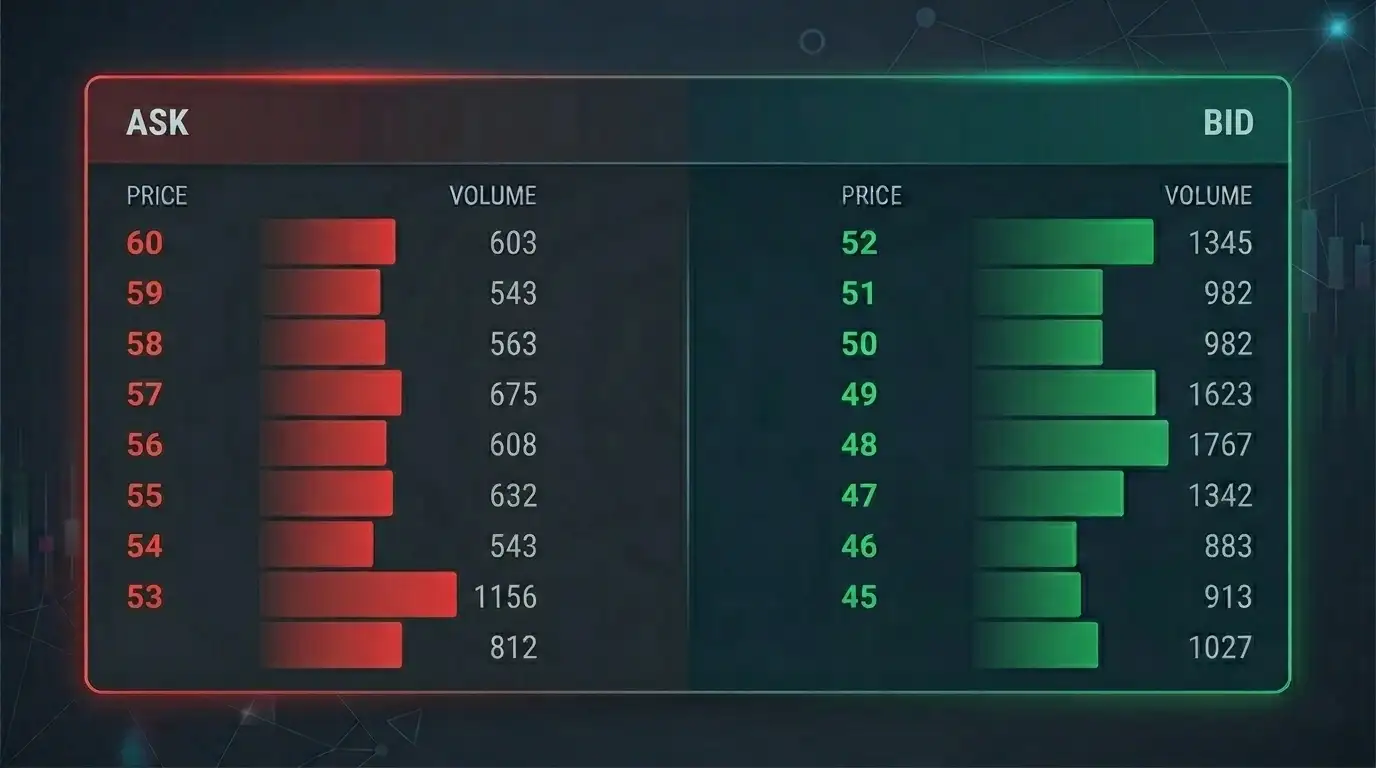
For example, if you place a market buy for 500 shares at 26c, and there are only 300 shares for that price, your next 200 shares would be filled at 27c then 28c, effectively moving the offer to 28c.
Here’s a paragraph you can slot in after the “What affects liquidity” section, before “How liquidity impacts your trading”:
What is liquidity provision and consumption
Some traders add liquidity to the market with limit orders while others take it away via market ones. In prediction markets, this distinction between liquidity provision and consumption matters more than most people realize.
When you place a bid, say, to buy “yes” shares at 45 cents, you’re putting up a limit offer that other traders can hit. That makes you a liquidity provider. On the flip side, when you come in with a market order, you’re consuming liquidity from someone else.
A healthy market has a good mix of both: active traders consuming liquidity keep prices moving and attract more providers looking to earn the spread. When provision dries up during high-uncertainty periods the market becomes harder to trade.
What affects liquidity
Several key factors drive liquidity in prediction markets, let’s break them down.
Participation levels: The more traders showing up to a market, the easier it is to find a counterparty. High-profile events like U.S. presidential elections or Fed decisions tend to draw in a large crowd, keeping volumes high and prices tight. In contrast, contracts on local elections in Nepal or niche sports like curling can dry up quickly because fewer people are excited enough to trade them.
Time to resolution: Markets that are close to resolving tend to see a pickup in activity. As the outcome becomes clearer, traders either look to lock in profits or cut their losses, which generates volume. Far-out markets can sit dormant for weeks.
Market uncertainty: When uncertainty spikes, say, an overnight airstrike or an unexpected rate hike, liquidity can evaporate fast. Because traders pull back their orders to avoid getting caught on the wrong side, the spread between yes and no can widen dramatically.
Event coverage: Markets tied to well-covered events with clear resolution criteria tend to hold up better in terms of liquidity. Ambiguous markets where the outcome definition is fuzzy often struggle to bring in serious traders.
How liquidity impacts your trading
Liquidity has a direct effect on the real cost of trading in prediction markets.
Spreads: The gap between the buy (ask) and the sell (bid) price is effectively your entry cost. In liquid markets, this spread can be just one or two cents. In illiquid ones, you might be giving up ten cents or more just to open a position, which eats into your profit before the market even moves.
Slippage: If you try to open a position, you may find that you can’t fill the whole order at the quoted price. The market starts moving against you as your order works through the available liquidity.
Exit difficulty: Getting into a position is one thing, getting out is another. In illiquid markets, you may find yourself stuck holding shares you want to offload unless you don’t mind a 26-cent slippage, especially near resolution and the outcome becomes 99% certain.
How to measure liquidity in prediction markets
Next, let’s explore a few practical metrics to help you size up a market before jumping in.
Order book depth: Most platforms let you look at how many shares are available at each price level. A healthy market has meaningful volume stacked up on both sides across several price points, not just a handful of shares at the top.
Trading volume: Total shares traded over the last 24 hours or seven days is a quick proxy for how active a market is. Low volume usually signals that you’ll run into friction when trying to trade.
Open interest: The total number of shares outstanding tells you how much money is tied up in the market. Higher open interest generally points to stronger engagement and better liquidity.
How to trade based on market conditions
In liquid prediction markets such as presidential elections, inflation reports, or world championships, fills are more reliable so you can go faster with market orders. These include:
- Momentum
- Breakout
- Arbitrage
In illiquid markets, do not chase but slow things down instead. Limit orders are your best friend, letting you set a price and wait for the market to come to you. Position sizing needs to come down, and you have to factor in the real cost of getting out before you ever get in. Popular strategies include:
- Mean reversion
- Fading news overreaction
Wrapping up
Liquidity can make or break your experience as a trader. By checking liquidity from the start, with spreads and volume, you can match your strategy to the market condition, and give yourself a solid edge over those who just jump in without thinking it through.